Beyond the Bling: 5 Truths Behind Silver’s Historic 150% Rally in 2025

While gold often steals the spotlight in the world of precious metals, 2025 was undeniably the year of silver. After nearly a decade of lagging, the metal shifted from a “forgotten asset” to one of the year’s biggest and most powerful financial stories, capturing the attention of investors worldwide with a staggering performance that rewrote the narrative.
This wasn’t just a rally; it was a fundamental repricing, driven by the collision of insatiable high-tech demand with a supply chain stretched to its breaking point. Below, we explore the five most surprising and impactful takeaways that explain how silver finally woke up and delivered one of the most remarkable rallies in recent memory.
1. It Didn’t Just Beat Gold—It Lapped It
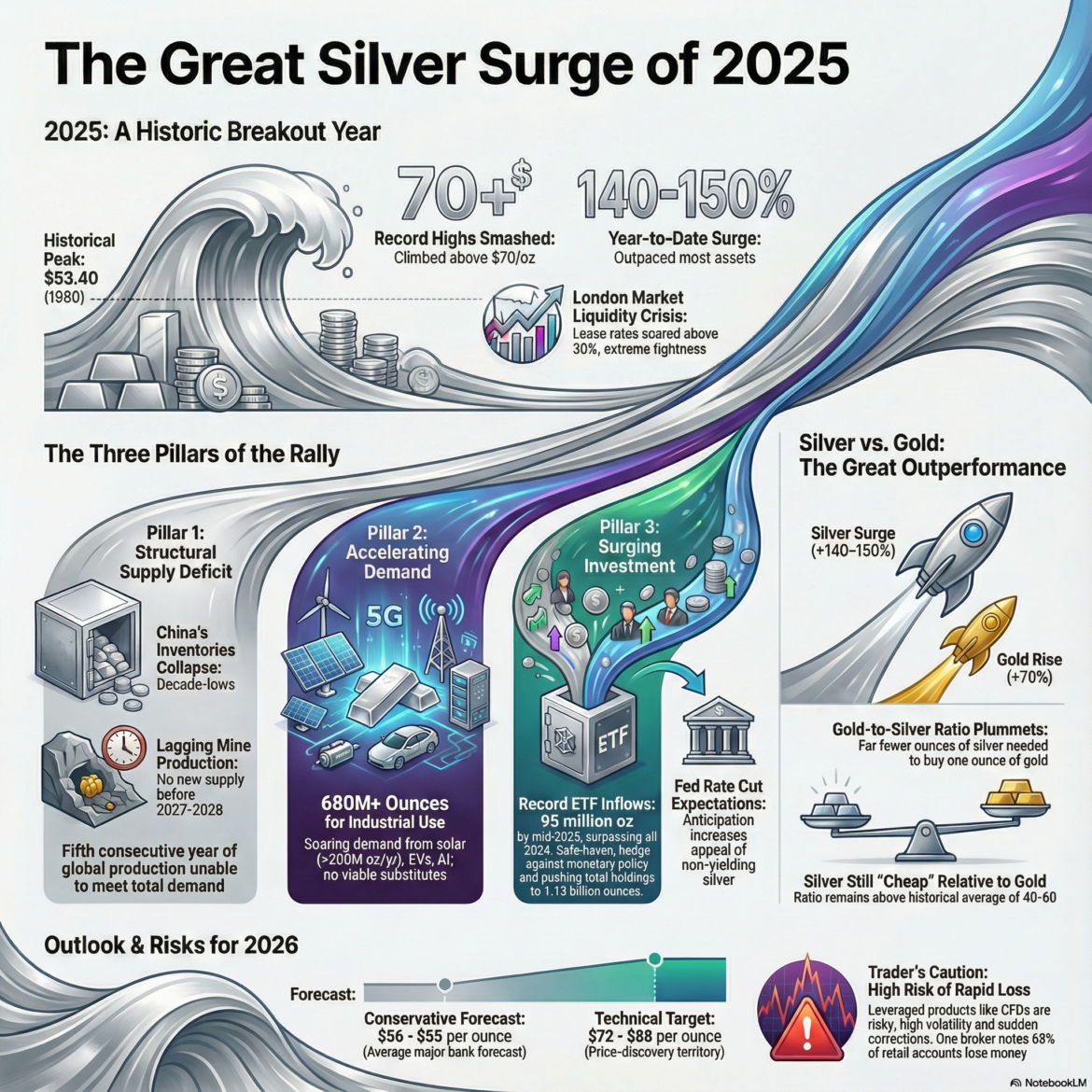
The most remarkable aspect of silver’s 2025 performance was its dramatic outperformance relative to gold. While gold itself had a strong year, rising roughly 70%, silver surged over 140–150% year-to-date, leaving the yellow metal far behind.
This significant divergence caused the gold-to-silver ratio to drop sharply, meaning far fewer ounces of silver are now needed to purchase one ounce of gold. This shift signaled a clear rotation of capital and a conviction that silver’s fundamentals offered more explosive upside than gold’s. This rapid compression of the gold-to-silver ratio brought it to levels not seen in years, marking a decisive end to silver’s decade-long underperformance.
2. It’s an Industrial Superpower, Not Just Pretty Metal
A key driver behind silver’s outperformance is its dual role as both a precious metal and an essential industrial commodity—a characteristic gold largely lacks. This industrial demand is not just stable; it’s accelerating, creating a powerful price foundation.
Silver is a critical and irreplaceable component in many of the world’s most vital high-growth technologies. Its major industrial uses include:
- Solar panels, which consume over 200 million ounces annually.
- Electric vehicles (EVs).
- 5G infrastructure.
- High-efficiency semiconductors.
- AI data centers, which require unparalleled electrical efficiency, relying on silver’s superior conductivity in high-performance components.
Crucially, there are no real substitutes for silver in these high-tech applications. Past attempts to replace it have either failed or resulted in inferior performance, creating a structural demand that is only projected to grow.
3. The World Is Running into a Structural Silver Shortage
The silver market is in its fifth consecutive year of a supply deficit, a fundamental imbalance where global demand consistently outstrips new supply. This long-term trend reached a critical point in 2025 as the market finally accepted its structural nature.
Mine supply cannot expand quickly to meet the surge in demand. Most new production is not expected to come online before 2027–2028. For the market, this means the current supply tightness isn’t a temporary spike—it’s the new baseline for the foreseeable future.
This deficit is draining available stockpiles. Above-ground inventories are thinning out, highlighted by the collapse of exchange-tracked inventories in China—the world’s most important physical hub—to decade lows.
Massive investment demand has further tightened the market. By mid-2025, a staggering 95 million ounces had flowed into silver-backed ETFs. These purchases remove physical silver from the available supply to be held in vaults, pushing total global holdings to 1.13 billion ounces valued at over $40 billion and amplifying the physical scarcity.
This kind of price action usually means one thing: the market has finally accepted that the supply/demand imbalance is structural, and it’s getting deeper.
4. A Market “Squeeze” Broke a 45-Year-Old Record
In a moment traders will remember for decades, silver’s spot price surpassed $53.40 per ounce in 2025. This move broke the previous all-time high set in 1980 during the Hunt brothers’ legendary attempt to corner the market, a record that had stood for 45 years. While the breaking of the $53.40 Hunt Brothers’ record was a historic milestone, the rally’s momentum would eventually carry silver prices above $70 per ounce later in the year.
The breakout was driven by an acute scarcity, or “liquidity crunch,” in the London Bullion Market, the center of global silver clearing. The effects were dramatic: one-month silver lease rates—the cost to borrow the metal—soared above 30%, signaling extreme stress. The price difference between London and New York became so wide that traders chartered transatlantic cargo flights to physically move bullion and capture arbitrage spreads that, at their peak, reached up to $3 per ounce.
This wasn’t just paper traders getting squeezed; it was a direct consequence of the voracious, non-negotiable demand from solar and EV manufacturers draining physical inventories from exchange vaults. While the echoes of 1980 are unmistakable, today’s rally is driven by a “diffuse army of investors, ETFs, and algorithmic funds” rather than a single family. Nevertheless, the comparison highlights the extreme pressure on the physical market.
5. Bad Economic News Became Good News for Silver
Counter-intuitively, signs of a weakening U.S. economy helped fuel silver’s historic rise. While the U.S. posted strong 4.3% GDP growth in the third quarter, other indicators painted a softer picture beneath the surface.
Weakening consumer confidence and flat factory production suggested that economic growth was beginning to slow. These mixed signals led markets to believe that the Federal Reserve would have to begin cutting interest rates in 2026.
This dynamic created a powerful tailwind: the prospect of lower rates simultaneously made silver a more attractive investment (vs. yielding assets) and a cheaper one for foreign buyers (via a weaker dollar).
Why Silver Price Today Is Hitting Historic Highs in 2025
Silver Price Today reflects a major shift in the global metals market, driven by booming industrial demand, limited supply, and strong investor interest. In 2025, silver emerged as one of the best-performing assets as shortages in physical supply collided with rising use in solar energy, electric vehicles, and advanced technology. This powerful combination has pushed prices to historic levels and changed how investors view silver—not just as a precious metal, but as a critical industrial commodity for the future.
Conclusion: A New Era for the “Other” Precious Metal?
The 2025 rally was no accident. It was the culmination of relentless industrial demand colliding with a deepening structural supply deficit, all amplified by strategic investor interest fueled by macroeconomic shifts. Together, these forces have fundamentally changed the narrative for silver.
After more than a decade in the shadows, was 2025 just the opening act for silver’s new era as a critical 21st-century commodity?