IRS Announces Gigantic Tax Refund for 2026 – Here Are 5 Reasons Americans Could Get Thousands More

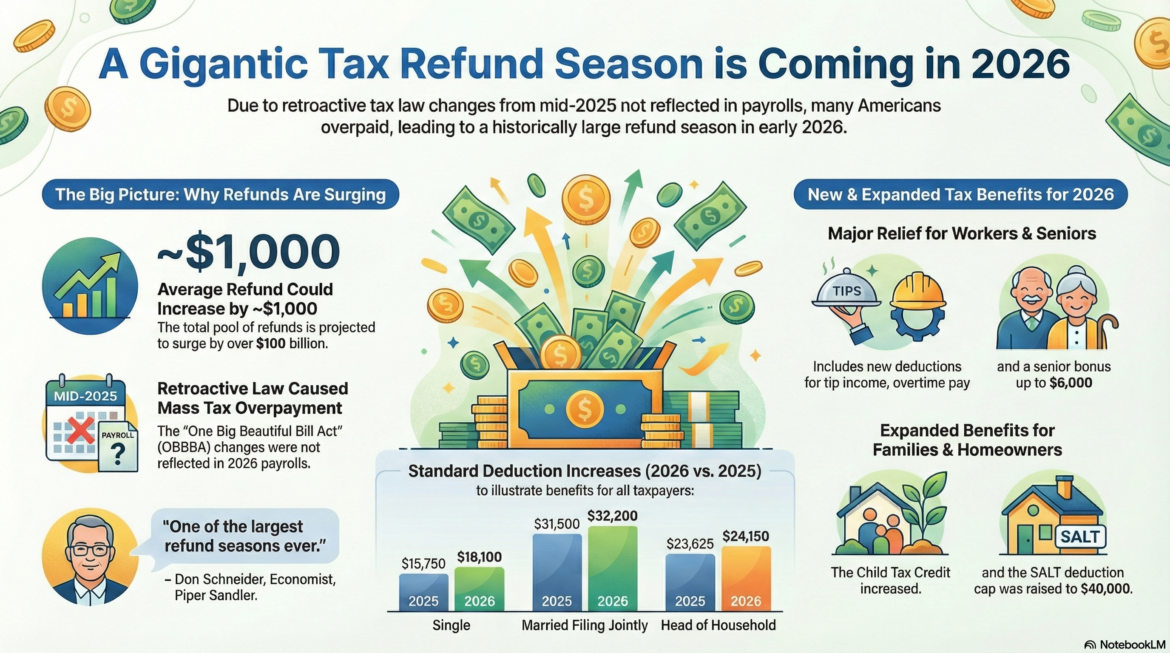
You’ve likely seen the official statements and headlines promising a “gigantic” tax refund season in early 2026. Government officials are projecting the largest tax refund season in American history, with many families potentially seeing returns thousands of dollars larger than usual. Estimates suggest the total pool of refunds could surge by over $100 billion, potentially increasing the average household’s return by roughly $1,000. But beyond the political talking points, what’s actually driving this expected windfall?
This article will cut through the noise and break down the five most significant and surprising changes behind this financial boost. From a unique timing issue in the tax code to brand-new deductions for specific workers, we’ll explore what these shifts mean for your personal finances and why your 2026 refund could be one for the record books.
1. The Real Reason for the Windfall: A Nationwide “Withholding Lag”
The single biggest driver of these massive refunds is a simple matter of timing. The “One Big Beautiful Bill Act” (OBBBA), which contained significant tax cuts, was signed into law in July 2025. However, its provisions were made retroactive to the very beginning of 2025.
Because these changes happened mid-year, most employers didn’t have time to adjust their employees’ payroll tax withholding rates. This created a “withholding lag” where millions of Americans effectively overpaid their taxes for more than half the year. That accumulated overpayment is now set to come back to taxpayers as a substantial, one-time refund when they file in 2026. In total, Treasury Secretary Scott Bessent projects this could inject an additional $100 to $150 billion directly into Americans’ pockets during the first quarter of 2026.
As Piper Sandler economist Don Schneider explains, this is a widespread phenomenon:
“People really aren’t adjusting their withholding this year. It would be pretty difficult to do so—you don’t even know how much of a tax cut you’re going to get from overtime or tips or something. When people go to file, I think they’ll be surprised by really, really large refunds.”
2. Brand New Deductions Target Specific Workers (And Car Buyers)
The 2026 tax season also introduces several new, specialized deductions designed to provide relief to specific groups of Americans. These go beyond the standard inflation adjustments and create new opportunities to lower your taxable income. Key additions include:
- A potential deduction of up to $25,000 in tip income for employees in the service and hospitality sectors.
- A new deduction for a portion of overtime pay.
- A unique deduction for the interest on new car loans, specifically for vehicles assembled in the United States.
What’s most surprising about these changes is how accessible some of them are. The new car loan interest deduction, for example, can be claimed even by taxpayers who take the standard deduction. This makes the benefit accessible to a much wider range of taxpayers who don’t typically itemize, making it a valuable benefit for a much larger group of car buyers.
3. A Massive Boost for Homeowners and Seniors
The new tax laws deliver substantial benefits to two key demographics: homeowners in high-tax states and senior citizens.
For homeowners, the cap on State and Local Tax (SALT) deductions has been dramatically raised from 10,000 to **40,000** for many households. This change provides significant relief for taxpayers in states like California, New York, and New Jersey, who have been constrained by the lower cap for years.
For seniors, the law introduces a new “Senior Bonus” deduction, which can provide up to $6,000 in additional relief for individual filers aged 65 and older who meet certain income requirements. Furthermore, Social Security Administration Commissioner Frank Bisignano highlighted a presidential commitment that Social Security benefits would not be taxed, which could provide another layer of relief for seniors if fully implemented.
4. Family-Focused Credits Get a Major Upgrade
Families with children are set to see some of the most direct benefits in the 2026 tax season. The Child Tax Credit (CTC) has been increased to 2,200 per qualifying child. More importantly, the refundable portion—the amount you can get back even if you owe no tax—has been raised to 1,700.
Alongside the enhanced CTC, the government is launching the “Trump Accounts” initiative. This new program for newborns offers tax-advantaged growth for savings and includes a potential $1,000 government contribution for eligible babies. The combination of these measures is heavily aimed at improving household financial stability.
5. A Word of Caution: Who Really Benefits?
While the promise of a “gigantic” refund is real for millions, a balanced perspective is crucial. Independent analysis suggests the benefits of the OBBBA may not be distributed evenly across all income levels.
The Congressional Budget Office (CBO) has warned that the new law will increase the U.S. deficit. Furthermore, the CBO’s distributional analysis offers a critical takeaway: according to the Congressional Budget Office, households in the top 10 percent will see an additional $12,000 on average over the 2026 to 2034 period. In contrast, those in the poorest 10 percent are projected to lose approximately $1,600 per year, partly due to cuts in other programs like Medicaid and food assistance. This detail adds a critical layer of insight, showing that while refunds are up for many, the long-term impact varies widely.
Conclusion: A Short-Term Boost and a Long-Term Question
The upcoming 2026 tax season is shaped by a unique combination of retroactive tax cuts, targeted new deductions, and broad inflation adjustments. For over 94% of middle-class Americans, a larger-than-usual refund is what one financial analysis calls a “mathematical reality.” This historic refund season provides a significant, one-time financial boost for many families.
However, it also raises important questions about our nation’s long-term fiscal health. With this potential windfall coming your way, how will you put it to work?