5 Counter-Intuitive Truths Behind an American Icon
Long drive-thru lines, famously polite service, and an unwavering policy of being closed on Sunday. For most, this is the complete picture of Chick-fil-A a brand built on consistency and values that have fueled its ascent to the top of the fast-food industry.
But behind the “My pleasure” lies a more complex story. The brand’s greatest strengths its intensely controlled culture and uncompromising identity are also the source of its biggest struggles and vulnerabilities. This journey is defined by a series of strategic paradoxes that challenge its simple public image. Here are five counter-intuitive truths that reveal the real story of this fast-food giant.
1. They Make More Money Per Store Than Anyone—While Being Closed 52 Days a Year.
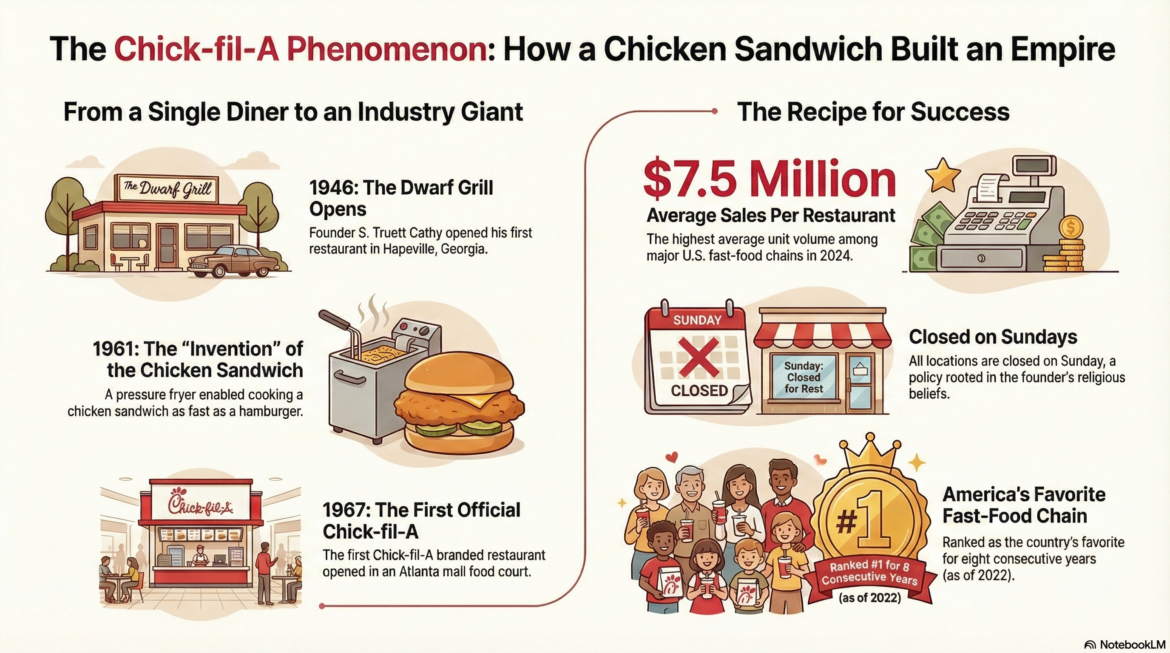
Chick-fil-A’s financial performance is nothing short of staggering. In 2024, the average unit volume for a Chick-fil-A restaurant was 7.5 million, the highest among major U.S. fast-food chains. What makes this truly remarkable is how they achieve it. The chain ranks third in the nation for total sales (22 billion), trailing only McDonald’s ($53.5 billion) and Starbucks. Yet, it accomplishes this with just 3,109 locations, a fraction of McDonald’s 13,559. They have built the most efficient money-making machine in fast-food history, all while being closed every Sunday, Thanksgiving, and Christmas.
This counter-intuitive dominance is often credited to a focused menu and legendary service. But the Sunday closing policy itself reveals the brand’s DNA. According to founder Truett Cathy’s son, Dan, the decision was as much about pragmatic business sense and personal well-being as it was about religious doctrine.
“by the time Sunday came, he was just worn out. And Sunday was not a big trading day, anyway, at the time. So he was closed that first Sunday and we’ve been closed ever since. He figured if he didn’t like working on Sundays, that other people didn’t either.”
While the policy is rigid, the company has made rare exceptions for charity, such as preparing meals for passengers stranded during a power outage at Atlanta’s airport, proving that for Chick-fil-A, culture can sometimes supersede even its most iron-clad rule.
2. You Can Become a Franchisee for Just $10,000.
In an industry where franchise buy-ins regularly exceed a million dollars,Chick-fil-A Paradox model is a radical departure. The initial investment to become an “Operator” is just US$10,000.
This is possible because the company retains ownership of the restaurant and real estate, covering the massive upfront costs itself. This is a brilliant strategic moat. By removing the barrier of personal wealth, Chick-fil-A can be exceptionally selective, choosing operators based on character and cultural alignment from tens of thousands of applicants. This model is the engine of their consistency, creating a highly vetted and indoctrinated corps of operators who serve as brand evangelists, ensuring the Chick-fil-A experience is nearly identical from Georgia to Oregon.
3. Their Global Expansion Has Been Full of Failures.
While Chick-fil-A is a titan in the U.S., its attempts to export its brand have been fraught with difficulty. The very cultural identity that powers its domestic success has often proven to be a liability abroad.
- South Africa: The company’s first venture outside North America, launched in the late 1990s, was unprofitable and closed by 2001.
- United Kingdom: Multiple attempts to open in the UK were met with protests. Locations in Reading and Scotland were quickly closed after public backlash regarding the company’s historical donations to anti-LGBTQ organizations.
However, these failures triggered a strategic pivot. After the UK closures, the company appointed its first head of diversity in 2020 and refocused its charitable activities on education and hunger alleviation. Armed with this adjusted strategy, Chick-fil-A has announced renewed plans to invest over $100 million to expand into the UK, Europe, and Asia. This next chapter will be a significant test of whether the brand’s famously rigid culture has learned to adapt for a global stage.
4. They Sued a T-Shirt Maker Over the Phrase “Eat More Kale.”
The “Eat Mor Chikin” campaign, featuring spelling-challenged Holstein cows, is a cornerstone of Chick-fil-A’s brand. The company vigorously protects this intellectual property, but one case revealed a rare chink in its armor of meticulous brand control.
In 2011, Chick-fil-A sent a cease and desist letter to Bo Muller-Moore, a Vermont artist screen printing T-shirts that read “Eat More Kale.” The company argued the phrase would “cause confusion of the public” and dilute its trademark. The move backfired spectacularly, sparking a public outcry against what Vermont’s governor called “corporate bullying.”
In a stunning David-versus-Goliath outcome, the artist fought back. Aided by pro-bono law students, he won. In 2014, the U.S. Patent Office granted Muller-Moore the trademark for his phrase, a rare public relations defeat for a company that typically manages its image flawlessly.
5. They Recently Backtracked on Major Animal Welfare and Antibiotic Pledges.
For years, Chick-fil-A cultivated its premium brand image with public commitments to high-quality, “clean” ingredients. That reputation makes two recent policy reversals particularly jarring for its loyal customer base.
- Antibiotics: After pledging in 2014 to serve chicken raised with “No Antibiotics Ever” (a goal met in 2019), the company announced in March 2024 it was shifting to a weaker standard of “No Antibiotics Important To Human Medicine (NAIHM).”
- Cage-Free Eggs: In 2016, the company pledged to use 100% cage-free eggs by 2026. They have since announced a reversal of this commitment, citing industry dynamics and the impact of bird flu on supply.
These changes represent far more than a logistical challenge. This is a high-stakes test of brand trust, questioning whether a premium brand can dilute its quality promise in the face of operational reality without eroding the fierce loyalty it spent decades building.
Conclusion
From its hyper-efficient financial model to its struggles with global cultural resonance, Chick-fil-A is a far more complex company than its simple, friendly image suggests. It is a masterclass in how a powerful, uncompromising culture can be a brand’s greatest strategic asset and, simultaneously, its greatest vulnerability. As the company forges ahead with massive global expansion, the defining question remains: which parts of its unique identity will it adapt, and which will it be forced to change?